
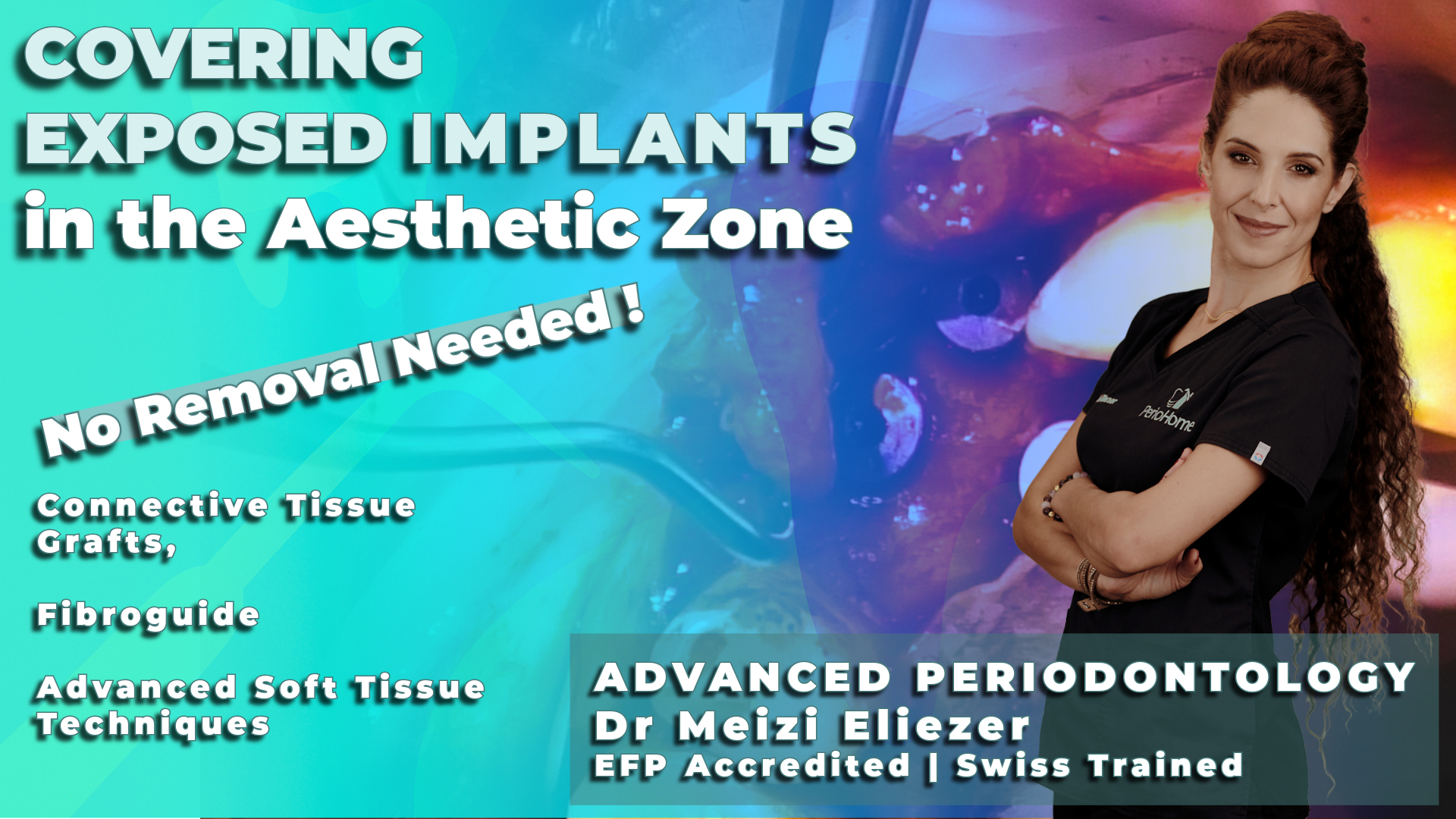
A Clinical Case Study with Subepithelial Connective Tissue Grafting and Fibre Guide In modern periodontology, preserving the patient’s aesthetic outcome often requires more than biological integration — it demands surgical precision, restorative collaboration, and creative problem-solving. In this in-depth clinical case, Dr. Meizi Eliezer showcases a comprehensive soft tissue augmentation technique to conceal osseointegrated implants in the aesthetic zone, using subepithelial connective tissue grafts and Fibre Guide biomaterials. This article complements the full surgical video on our YouTube channel and is intended for clinicians seeking to refine their approach to soft tissue management around implants.
Clinical Background: When Passive Eruption Meets Static Implants
The patient was referred by a prosthodontist and a maxillofacial surgeon. Although the implants were well-integrated, they remained visibly static as the natural dentition experienced passive eruption. This created a mismatch in the gingival margin during smiling — a major esthetic concern. Removing the implants wasn’t an option due to:
- Advanced osseointegration
- Risk of significant bone loss
- Surgical morbidity The interdisciplinary decision: cover the implants with soft tissue and provide a prosthetic solution that respects the patient’s biological and aesthetic needs.
Surgical Objectives
Surgical Approach: Step-by-Step Highlights
🔹 Subepithelial Connective Tissue Graft Harvesting Tissue was harvested from the palatal donor site, ensuring volume and quality for the recipient bed. Care was taken to minimise morbidity by using Fibre Guide to restore the donor site. 🔹 Pedicle Flap Elevation & Tunneling A partial-thickness flap was elevated with precision. Dr. Meizi used tunneling instruments to create a recipient bed without detaching vital blood supply — a critical factor in graft success. 🔹 Tissue Transfer & Graft Placement Palatal connective tissue and free soft tissue were repositioned from the palatal to the buccal side. This was combined with the autogenous graft to increase tissue thickness both vertically and horizontally. 🔹 Suturing Protocol A meticulous suturing strategy included: 🔹 Donor Site Management with Fibre Guide To accelerate healing and reduce discomfort, Fibre Guide was inserted at the palatal harvest site — offering both functional and regenerative benefits.
Why This Case Matters: Aesthetic Implant Complications
Soft tissue complications around implants — especially in the esthetic zone — are among the most complex challenges faced in modern implantology. This case demonstrates a conservative yet highly effective alternative to explantation: ✅ Maintains existing osseointegration ✅ Preserves bone and soft tissue ✅ Optimises prosthetic outcomes ✅ Minimises patient trauma
Clinical Pearls
✔ There’s no such thing as “too many sutures” if tissue is not well-adapted ✔ Passive eruption is often overlooked during implant planning — reassess before final prosthetics ✔ Use tunneling techniques to maintain vascularisation and reduce scarring ✔ Fibre Guide offers excellent healing support for palatal donor sites ✔ Always measure both tissue thickness and implant fenestration zones for surgical planning
Watch the Full Surgery
See the complete surgical procedure, including before/after visuals, flap handling, graft transfer, suturing, and healing management. Watch related video
About Dr. Meizi Eliezer
Dr. Eliezer is a Swiss-trained periodontist and implant specialist, accredited by the European Federation of Periodontology (EFP) and currently pursuing a PhD in Periodontology. Her clinical practice at PerioHome focuses on advanced soft tissue management, aesthetic implantology, and long-term surgical outcomes.